Why you hit it well at the range but not on the course
The range gives you the same club, a flat lie and a second try. The course gives you none of those.
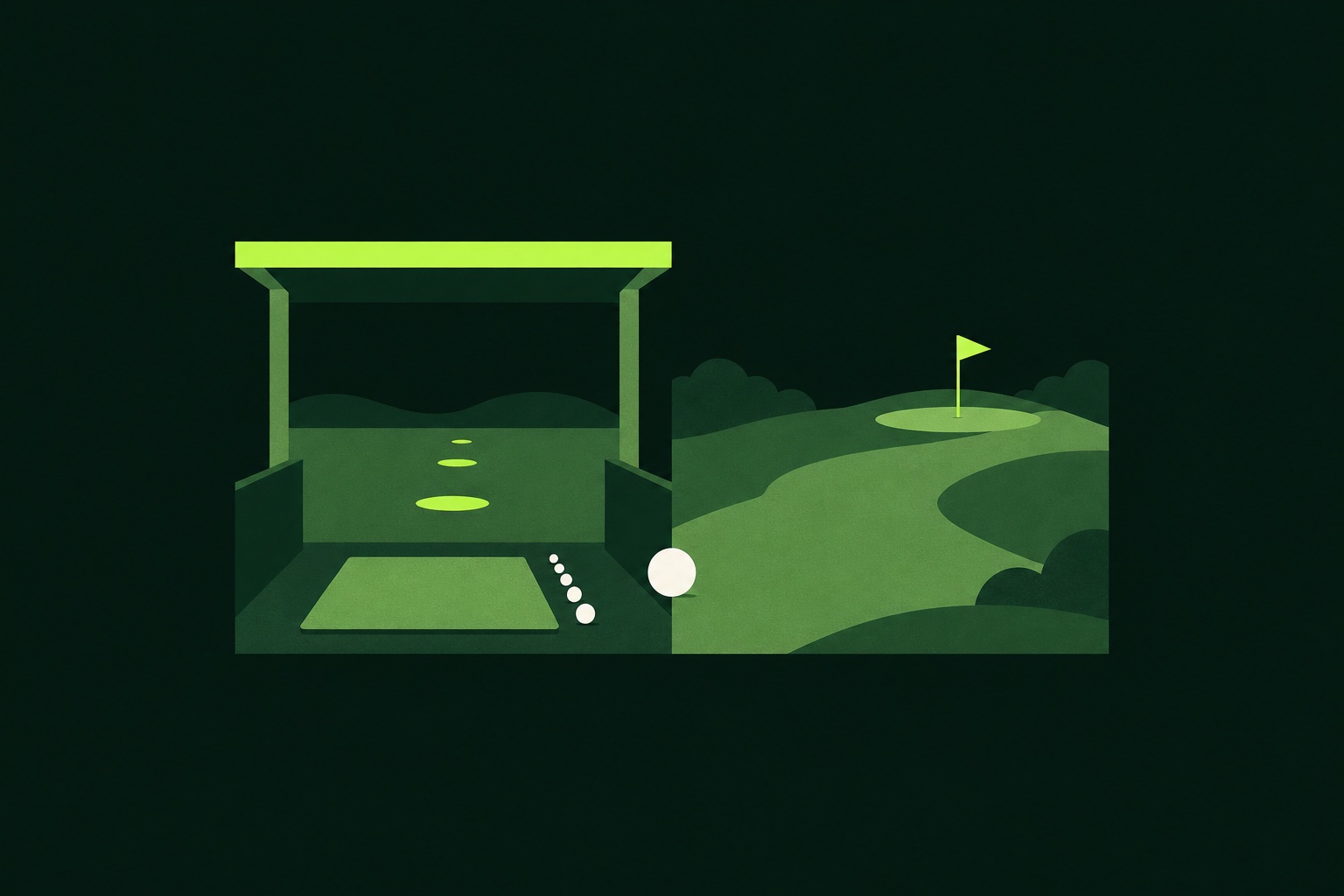
You hit it well at the range and poorly on the course because they are different tasks. At the range you hit the same club from a flat lie every 15 seconds, with no penalty for a miss. On the course you get one try, with a different club each time, several minutes after your last swing. A swing that depends on rhythm from the previous ball has nothing to lean on.
What the range takes away
- Consequences. A bad range ball costs nothing, so you swing freely.
- Time between swings. By ball 20 you are in a groove that does not exist on the first tee.
- A real target. Most range balls are hit toward the field, not at something narrow.
- Uneven lies. Mats are flat and forgiving. See what range mats hide.
- A routine. Few golfers go through their full routine on range balls, so the routine is never practiced.
Practice so it carries over
- Split the bucket. Use the first two thirds for your swing work. Use the last third to play golf.
- One ball per target. Pick a target, pick a club, go through your full routine, hit once. Then change both.
- Play your home course. Driver at an imaginary fairway between two flags, then the iron you would have left, then a wedge.
- Wait. Step off the mat and count to 30 between shots for the last ten balls. It feels slow because the course is slow.
- Keep score. Out of ten drives, how many finished between your two flags? Write it down and try to beat it next time.
Watch your tempo
Many golfers get quicker when a shot matters. The backswing shortens and the downswing starts early. If your misses on the course are pulls, tops and blocks that you never see on the range, a rushed transition is a likely cause. The rushed tempo drills are built for it, and Count-to-Four Tempo is the one to start with.
Test it before you take it to the course
A swing change is ready for the course when it holds up without the groove. PocketCaddie gives every swing a Good, Close or Out in Quick Start, so you can run the one-ball, full-routine game and see whether your swing still lands in range when the pace slows down. Your phone stays in your pocket the whole time.
PocketCaddie is available on iOS and Android.
PocketCaddie is the coach in your pocket that learns your swing. No video. Just golf.